
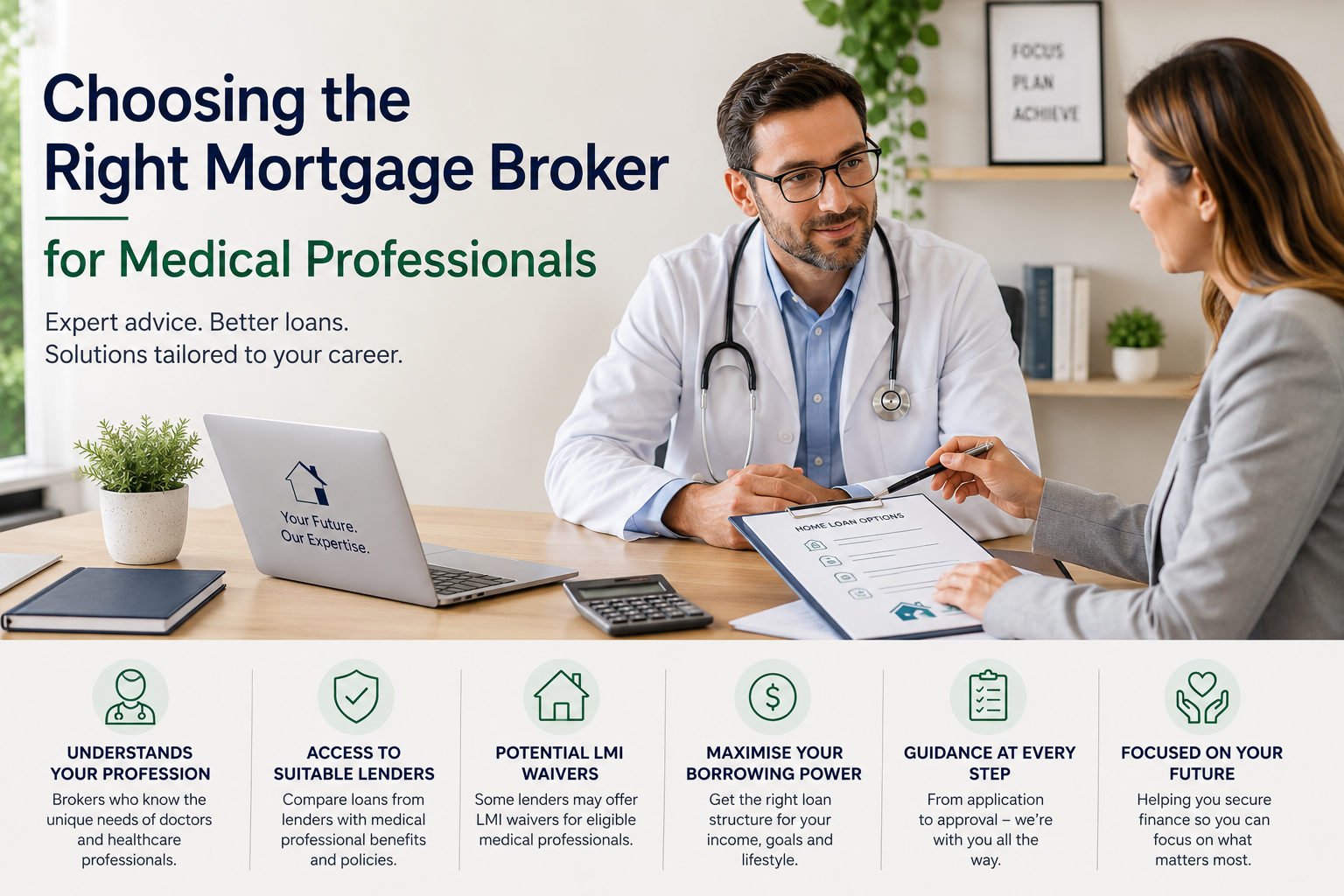
Mortgage Brokers for Medical Professionals: How to Choose the Right One
Doctors and other medical professionals can have unique financial circumstances when applying for a home loan. Strong earning potential can work in their favour, but factors such as overtime, allowances, multiple employers, locum work, private practice income and HECS/HELP debt can make a mortgage application more complex.
Some Australian lenders also offer specific lending benefits to eligible medical professionals, including potential Lenders Mortgage Insurance (LMI) waivers and higher Loan-to-Value Ratio (LVR) lending.
For these reasons, choosing a mortgage broker who understands medical professional lending can be valuable.
But with so many mortgage brokers available, how do you know which one is right for you?
Here are the key factors medical professionals should consider when choosing a mortgage broker.
Why Choose a Mortgage Broker With Medical Lending Experience?
Not every mortgage broker specialises in medical professionals, and a specialist broker isn't essential for every borrower. However, experience with doctors and healthcare professionals can be helpful.
Medical professionals can have income structures that differ from standard salaried employees. A hospital doctor might earn a base salary plus overtime, on-call payments, allowances and penalty rates. A specialist might receive income from multiple hospitals as well as a private practice, while a locum doctor could work across several healthcare facilities.
An experienced broker may already understand these arrangements and know which lenders on their panel have policies suitable for different types of medical income.
Look for Experience With Medical Professionals
One of the first things to consider is whether the broker regularly works with healthcare professionals.
The lending needs of a junior doctor purchasing a first home can be very different from those of an established surgeon purchasing an investment property or a dentist operating a private practice.
Relevant experience can help a broker understand these differences and identify lending options appropriate to your circumstances.
What to Look for in a Mortgage Broker
What to Consider | Why It Matters |
|---|---|
Medical lending experience | A broker familiar with doctors and healthcare professionals may better understand their income structures and lending needs. |
Access to suitable lenders | Different lenders have different policies and benefits for eligible medical professionals. |
Knowledge of LMI waivers | Some eligible medical professionals may qualify for LMI waivers or concessions with certain lenders. |
Understanding of complex income | Overtime, allowances, locum work and private practice income may be assessed differently between lenders. |
Self-employed lending experience | Practice owners and self-employed doctors may have additional documentation and lending requirements. |
Clear fees and commissions | A broker should clearly explain how they are paid and any costs that may apply. |
Good communication | Flexible communication can be useful for medical professionals working long or irregular hours. |
Once you've identified brokers with relevant experience, it's worth looking more closely at the specific lending benefits they may be able to help you explore.
Ask About Medical Professional LMI Waivers
Lenders Mortgage Insurance is an important consideration for medical professionals purchasing property with less than a traditional 20% deposit.
For many standard borrowers, LMI may apply when the Loan-to-Value Ratio exceeds 80%. Depending on the property value and amount borrowed, the cost can be significant.
However, some lenders offer LMI waivers or concessions to eligible medical professionals.
A mortgage broker familiar with medical lending may be able to identify lenders on their panel that currently provide professional lending benefits for your occupation.
A useful question to ask is:
“Are there lenders that may offer an LMI waiver for my profession?”
Eligibility shouldn't be assumed simply because you work in healthcare. Requirements can vary depending on your profession, registration, income, property, loan amount and the lender's current criteria.
Consider the Broker's Lender Panel
Mortgage brokers generally compare products from a panel of lenders rather than every lender in Australia.
It's therefore important to understand which lenders your broker can access.
A larger lender panel doesn't automatically mean you'll receive a better loan, but your broker should be able to explain which lenders may suit your circumstances and why.
This is especially important for medical professionals because professional lending policies can differ significantly between lenders.
One lender may provide an LMI concession for your profession while another may not. There can also be differences in how lenders assess overtime, allowances and other sources of income.
Make Sure They Understand Your Income
For many doctors, income assessment is one of the most important parts of a mortgage application.
Your total earnings may include considerably more than your base salary.
Depending on your position, you could receive:
Base salary
Overtime
On-call payments
Shift penalties
Allowances
Locum income
Contractor income
Private practice income
Income from multiple employers
Different lenders can treat these income sources differently when calculating borrowing capacity.
If additional income represents a significant part of your earnings, ask the broker how lenders on their panel are likely to assess it.
A broker who regularly works with medical professionals should understand these income structures and be able to explain what documentation may be required.
Consider Your Career Stage
Medical professionals can have very different mortgage requirements depending on where they are in their careers.
A junior doctor, for example, may have recently completed years of education and have HECS/HELP debt and limited savings. However, overtime, weekend shifts and allowances may increase their actual income beyond their base salary.
An established specialist may have multiple income sources, investment properties or a private practice.
Similarly, a dentist or GP operating their own practice may need a lender comfortable assessing self-employed or business income.
When choosing a mortgage broker, consider whether they have experience working with borrowers at a similar career stage and with a similar income structure.
What About Self-Employed Medical Professionals?
If you own a medical practice or operate through a business structure, choosing a broker with experience in self-employed lending may be particularly useful.
Self-employed mortgage applications can require additional documentation compared with applications from salaried employees.
Depending on the lender and circumstances, this may include tax returns, financial statements, notices of assessment and other evidence of business and personal income.
A broker familiar with self-employed medical professionals can help explain these requirements and identify lenders on their panel whose policies may suit your circumstances.
Look Beyond the Interest Rate
Interest rates are important, but choosing a mortgage based solely on the advertised rate may not give you the most suitable outcome.
There are other costs and features to consider, including:
Application and ongoing fees
Offset accounts
Redraw facilities
Fixed or variable interest options
Additional repayment options
Loan flexibility
Refinancing considerations
For example, someone with variable monthly income may value the ability to make additional repayments and access an offset account.
A good mortgage broker should explain both the costs and features of the loans they recommend rather than focusing solely on the headline interest rate.
Ask About Fees and Commissions
It's also important to understand how your mortgage broker is paid.
Mortgage brokers may receive commissions from lenders when they arrange home loans. Depending on the broker and the services provided, other fees may also apply.
Your broker should clearly explain their remuneration and disclose relevant commissions or fees.
Don't hesitate to ask questions if you're unsure about a cost or how the broker is compensated.
Communication Matters
Doctors and healthcare professionals often have demanding schedules involving long shifts, weekend work and on-call responsibilities.
A broker's communication style can therefore make a significant difference to the experience.
Consider whether the broker can communicate in a way that suits your schedule. Online meetings, electronic document submission and flexible communication can make the mortgage process easier to manage.
A good broker should also be able to explain lending terminology and recommendations clearly without making the process unnecessarily complicated.
Questions to Ask Before Choosing a Mortgage Broker
Before deciding which broker to work with, consider asking:
Do you regularly work with doctors or medical professionals?
Which lenders are included on your panel?
Could my profession qualify for an LMI waiver?
How will lenders assess my overtime, allowances or additional income?
Do you have experience with junior doctors, locums or self-employed medical professionals?
What fees or commissions apply?
Why are you recommending this particular lender and home loan?
A good broker should be able to answer these questions clearly and explain why their recommendations may be suitable for your circumstances.
Find a Mortgage Broker for Medical Professionals
Choosing the right mortgage broker isn't simply about finding someone who can submit a home loan application.
For doctors and healthcare professionals, it can be beneficial to find a broker who understands medical income structures, professional lending policies and potential benefits such as LMI waivers.
Your individual needs will depend on your profession, income, deposit, career stage, existing financial commitments and property goals.
Taking the time to compare brokers can help you find someone with the relevant experience and approach for your situation.
Our directory makes it easier to find mortgage brokers who work with medical professionals across Australia.
Browse mortgage brokers by location and expertise, compare your options and connect with a broker who understands the lending needs of doctors and other healthcare professionals.